
Colonial era–1860
Slavery, cotton, and American growth
Under chattel slavery people were treated in law as property. Enslaved men, women, and children were forced to work, could be sold away from their families, and were denied the right to control the proceeds of their labor. They maintained kinship, shared knowledge, resisted bondage, and pursued freedom under severe constraints. [Smithsonian]
By 1815 cotton had become the country's most valuable export. It remained dominant on the eve of the Civil War. Enslaved people grew and processed much of it, and slaveholders treated the people themselves as valuable capital. The benefits reached ports, merchants, shippers, banks, insurers, and Northern textile mills. Slave-produced cotton was a principal engine of nineteenth-century American trade and growth. The wealth made from it sharpened the political struggle over slavery’s expansion. [NPS economy history] [NPS cotton history] [Smithsonian]
Sources and further reading
- Slavery in America · Smithsonian National Museum of American History
- Industry and Economy during the Civil War · National Park Service
- The Cost of Cotton · National Park Service
1861–1865
War and emancipation
Slavery was central to secession and to the Civil War of 1861–1865. On January 1, 1863, the Emancipation Proclamation declared enslaved people free in designated areas in rebellion and authorized Black military enlistment. Black soldiers and sailors helped secure Union victory. The Thirteenth Amendment, ratified December 6, 1865, abolished slavery and involuntary servitude nationwide, except as punishment for a crime after conviction. [NPS Civil War history] [Emancipation Proclamation] [13th Amendment]
Freedom changed who could claim a person’s labor and control their movement. It came without a general transfer of land, savings, housing, or compensation for generations of forced labor. Those resources mattered immediately when freed families looked for homes and independent work.
Sources and further reading
- Slavery as a Cause of the Civil War · National Park Service
- Emancipation Proclamation · National Archives
- Thirteenth Amendment to the U.S. Constitution · National Archives
1865–1877
Land and institution-building in Reconstruction
What “40 acres and a mule” meant
On January 16, 1865, General William T. Sherman set aside designated abandoned or seized coastal lands in parts of South Carolina, Georgia, and northern Florida for settlement by freed families in plots of up to 40 tillable acres. Army mules were made available in some cases. It was a geographically limited military order. President Andrew Johnson’s restoration policies returned much of the land to pardoned former Confederate owners, displacing many settlers. On Edisto Island, South Carolina, freedpeople petitioned to keep the land they had begun working. That reversal made the phrase a lasting symbol of the gap between emancipation and economic independence. [Field Order No. 15] [NPS Reconstruction study] [Edisto Island petitions]
Citizenship, schools, and enterprise
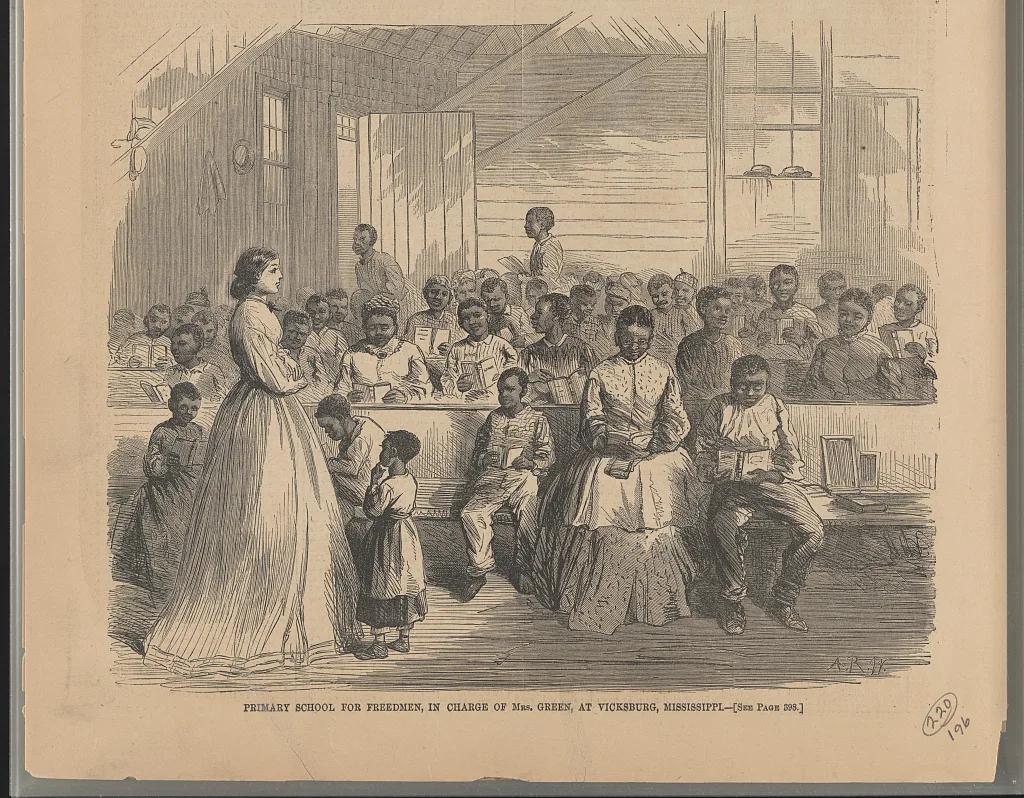
Freedpeople reunited families, pooled money, bought land, opened shops, and built independent churches, schools, and mutual-aid organizations. Black teachers and families drove the demand for education, with support from the Freedmen’s Bureau and other partners. The Fourteenth Amendment established birthright citizenship and equal protection. The Fifteenth barred denying the vote because of race, color, or previous condition of servitude. Black men organized, voted, and governed at local, state, and federal levels. New civil and political rights made building possible, while the means of making a living were still contested. [Bureau records] [African American Odyssey] [Reconstruction records]
Sources and further reading
- Special Field Order No. 15 · College of Charleston, Lowcountry Digital History Initiative
- The Era of Reconstruction, 1861–1900 · National Park Service
- Slave Emancipation Through the Prism of Archives Records · National Archives
- The Freedmen’s Bureau · National Archives
- Reconstruction and Its Aftermath · Library of Congress
- Emancipation and Reconstruction · Library of Congress
1865–1874 and after
Savings, debt, and coerced labor
The Freedman’s Bank
Congress chartered the Freedman’s Savings and Trust Company in 1865. It expanded rapidly, and tens of thousands of depositors used its branches to save military pay, wages, and other earnings. Fraud and abuse, mismanagement, overexpansion, hazardous investments, and the Panic of 1873 undermined it. Frederick Douglass became president in 1874 and tried to stabilize the institution. It still failed that year. Some customers eventually recovered part of their balances, but families lost savings and a financial institution they had trusted. [Bank records] [OCC bank history]
The terms of work
Beginning in 1865, Southern Black Codes restricted movement, work, and legal independence. Authorities used vagrancy laws to arrest people and in some states leased prisoners to private employers, where forced labor could be brutal. On farms, tenants might rent land for cash or crops, while sharecroppers paid with a share of their harvest. Contracts differed. A crop lien let a lender claim part of the future crop for goods advanced on credit, and debts could carry over. Peonage made debt a tool of compulsion when people were forced to work it off. These pressures were already in place when the election of 1876 put federal protection at risk. [Labor and Reconstruction] [Convict leasing records] [NPS Reconstruction study]
Sources and further reading
- The Freedman’s Savings and Trust Company and African American Genealogical Research · National Archives
- The Freedman’s Savings Bank · Office of the Comptroller of the Currency
- Reconstruction and Its Aftermath · Library of Congress
- The Convict Leasing System: Slavery in its Worst Aspects · Library of Congress
1876–early 1900s
The disputed election and the rise of Jim Crow
Rutherford B. Hayes, Republican, ran against Samuel J. Tilden, Democrat. Tilden led the popular vote. With electoral returns disputed in several states, Congress created an Electoral Commission. Hayes prevailed by 185 electoral votes to 184. Political understandings around his inauguration are commonly called the Compromise of 1877. Historians debate whether these amounted to one formally negotiated bargain. Federal troops were withdrawn from positions protecting the remaining Reconstruction governments in Louisiana and South Carolina. This is why 1877 conventionally marks the end of Reconstruction. [Electoral College results] [Election records] [National Archives on the compromise]
White supremacist violence and intimidation, court decisions narrowing federal protections, and declining Northern commitment had already weakened Reconstruction. Over time, poll taxes, literacy tests, and white primaries excluded many Black voters. Jim Crow imposed segregation. The Ku Klux Klan and other white supremacists used threats and violence, including lynching, to enforce racial control. Threats to a job, a lease, or a line of credit could also punish political participation. Black communities kept organizing and building under those conditions. [NPS Reconstruction history] [Jim Crow primary sources] [Voting rights history] [National Archives voting cases]
Sources and further reading
- 1876 Electoral College Results · National Archives
- Presidential Election of 1876: A Resource Guide · Library of Congress
- Inaugural Quiz: Compromise of 1877 · National Archives
- The Rise and Fall of the Freedmen’s Bureau · National Park Service
- Jim Crow and Segregation · Library of Congress
- Voting Rights · Library of Congress Civil Rights History Project
- Laws and Court Cases · National Archives
Late 1800s–mid-1900s
Communities built, attacked, and defended
Farms, towns, and commercial districts
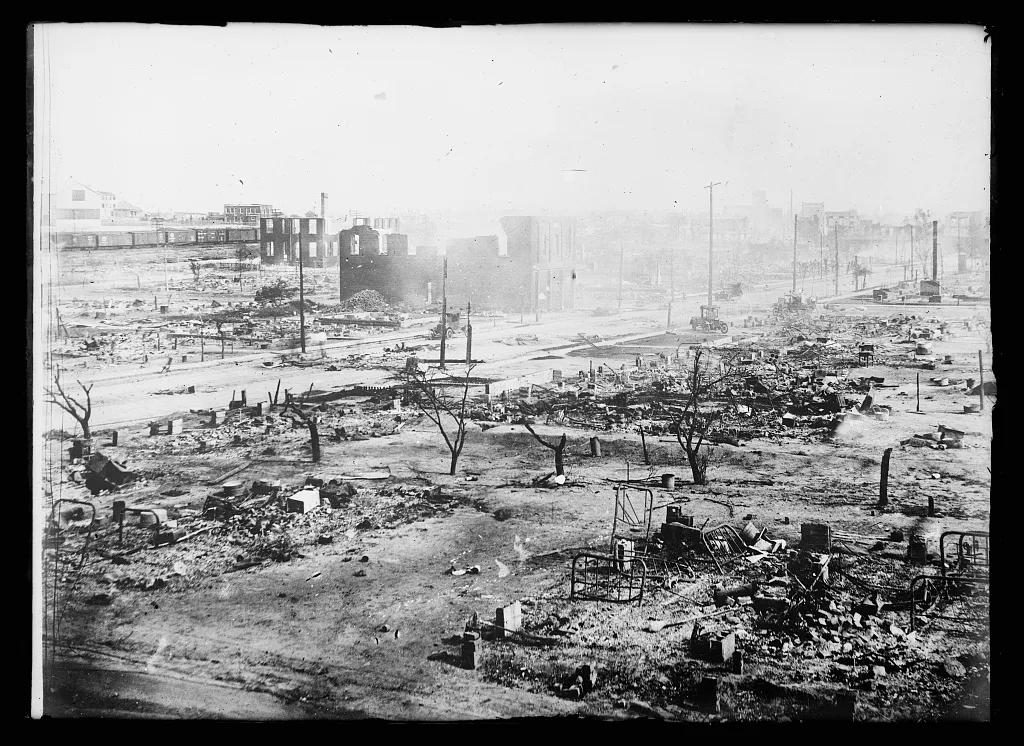
Black settlers founded Nicodemus, Kansas, in 1877, building a farming community with schools, churches, businesses, and civic organizations. In Tulsa’s Greenwood district, residents built shops, professional practices, homes, schools, and churches. In Wilmington, North Carolina, white supremacists attacked Black residents, burned the Black newspaper’s office, and overthrew the elected local government in 1898. The Red Summer of 1919 brought attacks in communities including Chicago and Elaine, Arkansas. In 1921 a white mob devastated Greenwood. Survivors went to work rebuilding homes and businesses. [Nicodemus history] [Wilmington records] [Red Summer records] [Greenwood records]
Why keeping land was hard
Black farmers acquired land after emancipation, and ownership grew into the early twentieth century. A farm could support income, food, housing, and the next generation. Over the twentieth century many farms were lost through a combination of agricultural restructuring, migration, unequal access to credit and USDA programs, tax sales, and forced sales of jointly owned land. [USDA Equity Commission] [USDA Forest Service research]
Heirs’ property can develop when several relatives inherit undivided shares and the title stays unsettled. This can make it harder to obtain financing or prove eligibility for assistance. A co-owner can sometimes ask a court to divide or sell the property. Families faced these risks even as relatives moved toward new jobs and opportunities. [USDA Forest Service research]
Sources and further reading
- Kansas: Nicodemus National Historic Site · National Park Service
- 1898 Wilmington Coup · North Carolina Department of Natural and Cultural Resources
- Racial Massacres and the Red Summer of 1919 · Library of Congress
- Tulsa’s Greenwood District: Exploring the Impact of the Tulsa Race Massacre · Library of Congress
- Equity Commission Final Report · U.S. Department of Agriculture
- Heirs’ Property and Land Fractionation: Fostering Stable Ownership to Prevent Land Loss and Abandonment · USDA Forest Service
1910–1970
The Great Migration
- West
- Los Angeles, Oakland, Portland, Seattle
- Midwest
- Chicago, Cleveland, Detroit, St. Louis
- Northeast
- New York, Philadelphia, Pittsburgh
Black people had moved west before the Great Migration, including settlers who made homes on the Plains. Between roughly 1910 and 1970, about six million Black Americans left the South for Northern, Midwestern, and Western states. Jim Crow, racial violence, restricted political power, and limited jobs pushed families to leave. Industrial work, wartime hiring, schooling, political opportunity, and family networks made destinations attractive. [Great Migration records]
Families established churches, newspapers, unions and civic associations, shops, and professional networks. In many cities, employers discriminated, violence accompanied attempts to enter segregated neighborhoods, and restrictive covenants and lending practices limited where families could buy homes. Home Owners’ Loan Corporation maps from the 1930s help document how race entered judgments about lending risk. As these cities grew, road building and redevelopment put some of the neighborhoods migrants had built under new pressure. [Great Migration records] [HOLC maps and descriptions]
Sources and further reading
- The Great Migration (1910–1970) · National Archives
- Mapping Inequality: Redlining in New Deal America · Digital Scholarship Lab, University of Richmond
1940s–1970s
Urban renewal and highway displacement
Midcentury urban renewal cleared homes and commercial property in the name of redevelopment. Interstate construction also displaced families and businesses or divided existing neighborhoods. In St. Paul, I‑94 cut through historically Black Rondo. Whether through demolition or a barrier across local streets, a project could scatter customers, tenants, workers, and institutions that depended on being near one another. A study tracking businesses listed in the Green Book found more declines in areas designated for urban renewal. [Smithsonian transportation history] [Green Book business study] [FHWA Rondo case study]
The federal government now documents efforts to reconnect neighborhoods physically separated by transportation infrastructure. Communities still have to make decisions about whose homes and livelihoods a project will affect. These struggles unfolded alongside campaigns for full access to schools, jobs, housing, and political life. [FHWA highway history]
Sources and further reading
- City and Suburb · Smithsonian National Museum of American History
- Black-Friendly Businesses in Cities During the Civil Rights Era · National Bureau of Economic Research
- Rethinking I-94 and Reconnecting Communities in the Twin Cities · Federal Highway Administration
- Reconnecting Communities and Neighborhoods · Federal Highway Administration
1954–1968
The modern Civil Rights Movement
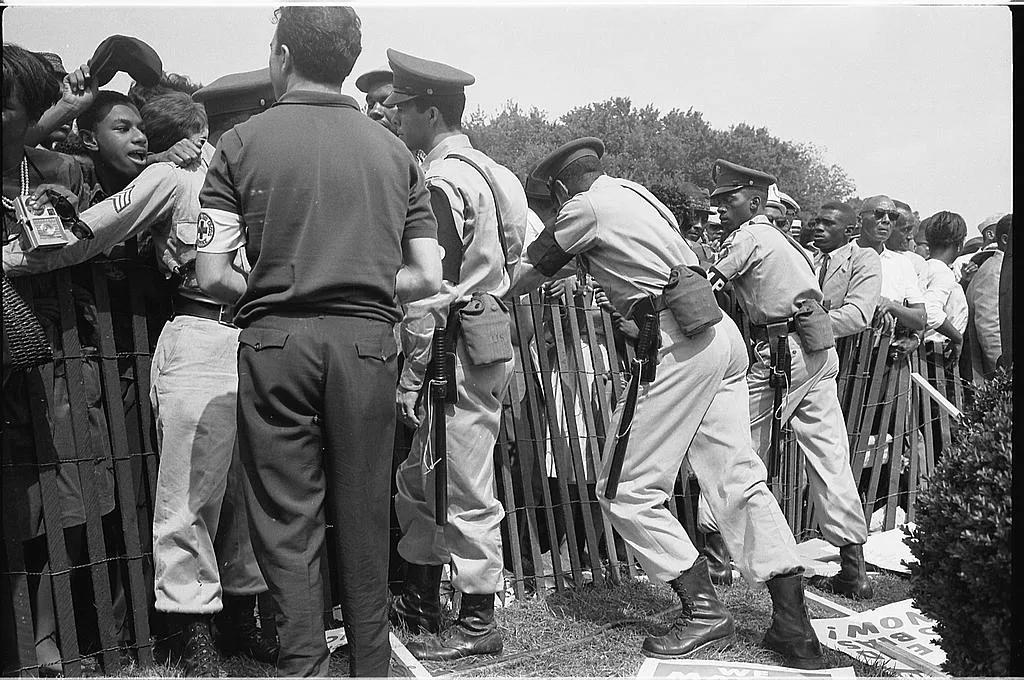
In 1954, Brown v. Board of Education held state-mandated segregation in public schools unconstitutional. Students, church leaders, local organizers, and workers pressed the movement forward through the Montgomery Bus Boycott, sit-ins, Freedom Rides, the Birmingham campaign, and the 1963 March on Washington for Jobs and Freedom. Freedom Summer in Mississippi and the 1965 Selma marches made the denial of voting rights impossible to ignore. [Brown decision] [Civil rights movement records] [Freedom Summer history] [1965 Voting Rights Act]
The Civil Rights Act of 1964 barred discrimination in covered public accommodations and employment. The Voting Rights Act of 1965 strengthened federal enforcement against racial discrimination in voting. The Fair Housing Act of 1968 barred discrimination in covered housing transactions. The gains were substantial. Where and how communities implemented the new rights shaped who could keep a job, a school, or a business. [1964 Civil Rights Act] [1965 Voting Rights Act] [1968 Fair Housing Act]
Sources and further reading
- Brown v. Board of Education · National Archives
- Civil Rights Era, 1950–1963 · Library of Congress
- Mississippi: COFO Civil Rights Education Center · National Park Service
- Voting Rights Act of 1965 · National Archives
- Civil Rights Act of 1964 · National Archives
- Civil Rights Act of 1968 · U.S. Government Publishing Office
1960s–late 1900s
Integration, schools, work, and family policy
Access and ownership
Integration opened schools, jobs, stores, and services that had long excluded Black Americans. In some districts, the way authorities consolidated schools also closed or downgraded historically Black schools and reduced jobs held by Black teachers and administrators. In commerce, access to more stores changed where some households shopped. Migration, suburbanization, highways, plant closures, competition from chains, lending barriers, and difficulties passing businesses to the next generation all affected local businesses. Their effects varied by place. Expanded rights increased opportunity, while retaining land, jobs, and firms demanded capital and durable institutions. [School employment study] [Smithsonian transportation history]
What a “substitute father” rule did
Some states used “man-in-the-house” or “substitute father” rules to determine eligibility for Aid to Families with Dependent Children (AFDC). Alabama treated some men who had relationships with mothers as substitute fathers, even without a legal duty to support the children. The rule could disqualify the children. In 1968 the Supreme Court held the Alabama regulation inconsistent with federal law in King v. Smith. Employment, housing, poverty, family law, and incarceration also affect family circumstances. The ruling documents a particular state practice and its consequences for eligibility. [King v. Smith]
Sources and further reading
- School Desegregation and Black Teacher Employment · Owen Thompson, National Bureau of Economic Research
- City and Suburb · Smithsonian National Museum of American History
- King v. Smith, 392 U.S. 309 · Supreme Court of the United States, via Library of Congress
Late 1900s–present
Disparities, progress, and ownership today
What incarceration statistics measure
Prisons generally hold people serving sentences. Local jails also hold people awaiting court action and people serving shorter sentences. A conviction is a finding of guilt. Probation and parole are ordinarily forms of supervision in the community. At midyear 2024, 68% of local jail inmates were unconvicted, a category that included people awaiting court action and people held for other reasons. [BJS jail report]
At year-end 2023, 1,218 non-Hispanic Black adults per 100,000 were under state or federal prison jurisdiction with a sentence longer than a year, compared with 231 per 100,000 non-Hispanic White adults. The Black adult rate was down 33% from 2013. These figures measure race and ethnicity, with no FBA lineage breakdown. They describe the size of a disparity, while explaining its causes requires evidence about decisions from policing and charging through sentencing and release. [BJS prison report]
What can be built now
Paired tests have found that Black renters and homebuyers were shown or told about fewer available properties, and hiring field experiments have documented unequal treatment. Access to financing affects who can own property and expand a business. Federal Reserve survey results show that barriers to obtaining financing persist for Black-owned startups. Gentrification refers to a shift toward higher-income residents and investment in a previously lower-income area. Rising rents, taxes, or property prices can increase pressure to move or sell, even as existing owners may see their property appreciate. The effects depend partly on who owns the assets and who can afford to stay. [HUD paired testing] [Hiring field experiments] [Federal Reserve small business survey] [Philadelphia Fed neighborhood study]
Black entrepreneurs already farm, manufacture, design software, provide professional services, and employ workers. Broader legal access and those achievements give communities something to build on. The directory exists to make that productive capacity easier to find and to help more of it grow through repeat customers, trade between businesses, training, and reinvestment. [Census business survey]
We cannot change the past. We can decide what we build from here.
Sources and further reading
- Housing Discrimination Against Racial and Ethnic Minorities 2012 · U.S. Department of Housing and Urban Development
- Employment Discrimination Faced by Individuals with Arrest and Conviction Records · Devah Pager, testimony to the EEOC
- Report on Startup Firms Owned by People of Color · Federal Reserve Banks
- The Effects of Gentrification on the Well-Being and Opportunity of Original Resident Adults and Children · Quentin Brummet and Davin Reed, Federal Reserve Bank of Philadelphia
- Prisoners in 2023 – Statistical Tables · Bureau of Justice Statistics
- Jail Inmates in 2024 – Statistical Tables · Bureau of Justice Statistics
- 2024 Annual Business Survey Tables · U.S. Census Bureau